Do we take too much for granted?

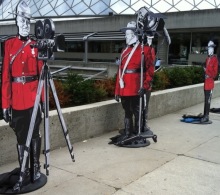
Today is election day in Canada and an opportunity for us to exercise a basic democratic right. And regardless of what we may think of our leaders or the number of times we’ve visited polling stations in recent years, it’s important for all of us to make the effort and vote.

I mean, think about how lucky we are to be Canadian. We have the ability to do something that millions of people all over the world are willing to risk their lives and fight for.   (more…)


What’s a book publisher to do?

I read about the bankruptcy of H.B. Fenn and Company, a venerable Canadian distributor and publisher, with a good deal of disappointment.  I love books and used to work in the industry and can’t help but feel saddened by the loss.

In part, the problem stems from Canadian distributors losing the rights to distribute titles from the big American houses because they are now going direct.  As a result, Canadian companies can no longer use the revenue from U.S. bestsellers to help defray costs for high-quality-lower-sales Canadian books.

So along with many other industries, the Canadian publishing and bookselling model is broken.   (more…)


Ghosts of blogging future

On Inside PR #2.17, Gini Dietrich and I talked about ghost blogging, a subject that has been haunting the blogosphere for a long time.  Much has been written about the ethics surrounding it. It’s a debate about authorship and authority. If your name appears on a blog, you should be the person who writes it.  Of course there are exceptions, like clearly identified guest posts, but other than that, the ‘rules’ are pretty rigid.

At the risk of unleashing the ire of ghost busters, I wonder if this approach has become too simplistic.

Blogs have moved beyond digital journals to become an effective publishing format. Seth Godin’s recent views on shifting from traditional to electronic publishing tie into this. Social media newsrooms are essentially blog platforms designed to distribute and share content and news without a single author’s point of view. With the confluence of portable digital devices, all-access Wi-Fi and the need to conserve scarce resources (i.e. trees), it’s easy to see how ‘blogger’ could become synonymous with ‘publisher’. A blog house could be the 21st century version of publishing house, home to commercial and non-commercial fiction, non-fiction, humour, travel, cooking, business, text books, anything really – even nameless instruction manuals. Now imagine we add video and real-time conversation to the mix…

I’m not saying we should abandon personal voices and ideas. Far from it. That’s where innovation begins before heading on its circuitous path from indie to establishment.

We should all strive for transparency and authenticity, yet maybe the blog-of-old has outgrown its initial framework and ghost blogging is no longer the issue it once was. Like the printing press, blogs could evolve into the catalyst that reshapes and redefines publishing. Now that’s a bestseller I wouldn’t want to miss!

What do you think?


Is speed slowing down original thought?

I was recently thinking about some of the great 20th century authors and the volumes they created using a typewriter to bang out their prose (or maybe a pen…). Starting with a finite blank page, typing, x-ing things out, reading it over, scribbling edits by hand, retyping and repeating till they felt their stories were complete. It was a long, solitary and arduous journey. And it produced works of genius.

And I wonder if the passion for immediacy in our web 2.0 world is running counter to that process.  I’m not saying we should hang onto the past. I am saying it sometimes feels like we’re trading speed for reflection.

Yes, we can spew out words and ideas on a keyboard (much like this), quickly read it over, spell check (hopefully), link and publish.  But how much time are we spending rewriting? Looking at our ideas from a different angle, a fresh perspective, the benefit of time; and then revising or maybe starting anew.

These days, I’m getting a lot of  mini aha moments; that is idea-bursts from blogs, tweets, articles and observations online.  And while these are energizing kernels of thought, sometimes they’re not enough. And I crave the brilliance I still get from certain authors or a great, sprawling conversation.

Perhaps we need the equivalent of writerly speed limits, i.e. slow down our prose, choose words more selectively, be a bit less prolific and take that extra time to consider before we hit publish or press send.

Sure we can all be writers. Maybe we need to become reflectors too.


My.sxsw – a recap

Now that the tweets have settled and FourSquare’s down to a dull roar (i.e. most days you’ll find me checked into my office), I thought I’d recap my experiences at this year’s South by Southwest Interactive Festival.

First the highlights:

I guess I’m a Panel Nerd at heart. I go to conferences to listen to people I wouldn’t otherwise have the opportunity to hear, learn things and hopefully open my mind.

Among the sessions that stood out for me were Christie Nicholson’s overview of the interface between human brains and computers. I wanted to try the EEG shower cap that non-invasively reads impulses outside the brain, especially when I saw the video of a journalist who thought of letters and saw them materialize on a screen in front of him.

Danah Boyd offered a challenging keynote on privacy and publicity in a world where we have become our own big brothers: ‘Now social media makes conversations public by default, private through effort. This is a complete shift in the way we used to act.’

Clay Shirky is as engaging and intellectually challenging in person as he is in his book. Here are two nuggets he shared: ‘Abundance is a bigger challenge to society than scarcity’ and ‘behaviour is motivation filtered through opportunity’.

I also enjoyed the networking and the opportunity to get to know new people and exchange ideas with them, as well as actually meeting some of the folks I’ve been reading/following for a while.  That said, you soon realize the stars of SXSWi can only been seen from the planetarium that is the Ausin Convention Centre and not from a middle-American night sky…

Now my.downside:

SXSW is a big party scene – I know that shouldn’t be news – and some people place a premium on VIP lists, jumping the cue and hoarse throats. Now, I went to a few soirees (hey, I am social), but honestly I preferred the ones where you could actually talk to people instead of screaming at the top of your lungs at someone who can’t hear you and who you know is nodding out of politeness. (Or maybe my age is showing.)

Evan William’s keynote was a  major disappointment. We were there to hear the Oracle of Tweet but what we got was a pompous interviewer and little insight. The two convention halls were overflowing at the start of the session and overflowing with people leaving halfway through.  It’s too bad. I’m sure with better questions, Williams would have had something to say.

The quality of the panels was definitely mixed.  I think there should be better curation and guidelines as to who can present on what topic in order to set higher standards. Maybe there should be fewer sessions, with presenters doing their talk more than once.  Also, every room should have had AV so you can hear what people have to say.

For me, the two worst sessions were: A guy who took us through a deck you knew he used to pitch new business – complete with client testimonials; and the panel where one woman extolled the virtues of ‘ads that look like content’ and then rushed out to catch a flight before answering questions, followed by a guy who was so hung-over he looked dumbfounded by every slide he incoherently presented.

If you want to hear more, have a listen to Inside PR #197 where Robert Scoble answers the 4Qs.  I also had an opportunity to interview Brian Solis and Chris Barger, who will be featured on upcoming episodes.

My good friend Gini Dietrich blogged about her decision not to go and makes some valid points.

Special thanks to Keith McArthur and Michelle Kostya for being my panel/social buddies.

Will I make the pilgrimage next year?  I think so – it’s hard to match the overall calibre and energy of the event and the fact that you have thousands of social media practitioners in one place at one time – all trying to figure out the next big social thing.


« Previous Entries

COPYRIGHT 2011 - MARTIN WAXMAN COMMUNICATIONS