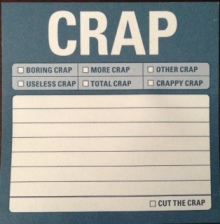
I cringe when I hear that expression.
More often than not, the person saying it is in marketing or PR and there's a wide gap between what they claim to be doing and what you see when you visit their sites.
They crow about having an active twitter feed (lots of followers), plenty of likes on their Facebook page, a popular company blog… And technically they have set them up.
It seems that way to me.
This notion first struck me during my recent digital clean-up; unsubscribing, sorting through and deleting various Facebook page 'likes', generally making choices and trying not to focus on so many shiny things. (For anyone who listened to Inside PR 2.82, you'll know that was my 2012 social media resolution.)
Of course we understand that just because we 'like' a brand doesn't necessarily mean we like it. In fact, it could be just the opposite. Say I've been on the receiving end of really bad customer service, I could like a page because at that moment I actually hate the company but liking is the only way I'll be allowed to have my public rant.
It's that time of year… my McMaster University social media course is in full swing and I want to introduce the class and their blogs.
This is the third time I've taught the course and as before, topics can be anything the students are passionate about. Because the group is from communications and marketing, the writing is strong and you can hear people's voices come through. And because they range in age from recent grads to boomers, you'll find an eclectic array of subjects. (more…)
I was at a meeting with a group of agencies not too long ago – PR, ad, digital and media buying. We were working together on a campaign that included various components from each of our firms. When the plan was presented, I was struck by the similarity of social media executions across all disciplines.
This is markedly different than it’s been in the past, when PR focused on publicity, events, speaking engagements, internal communications and other influencer outreach. Advertising was all about creative – usually TV, print and radio. Digital was the web presence; did someone say microsite? Media was spreadsheets and GRPs peppered with the occasional advertorial or promotion.
And the world turned…
This holiday, it feels like I’ve been treated to my fiction wish list with new books by two of my favourite authors, Kurt Vonnegut and Philip Roth. Roth’s is The Humbling, a short novel about acting and dying (literally); and Vonnegut’s is Look at the Birdie, a collection of early unpublished stories that very much ring true today. I’ve read one book and am halfway through the other and wish neither would end.
And speaking of books (now there’s a segue), I thought this is a good time to highlight and recommend a few social media reads that stood out for me in 2009. All three books offer insights on the lay of the social landscape and its growing importance to business.
They are (in no particular order):
SocialCorp by Joel Postman – I reviewed the book when it first came out and feel it’s a great starting point for any organization seeking a strategic approach to becoming more social. The writing is smart and crisp. Of particular interest are the case studies and Joel’s approach to ethics and transparency.
Six Pixels of Separation by Mitch Joel – I finally met Mitch in person this year (having been a reader/listener for a long time) and thoroughly enjoyed his book. Again, it’s aimed at businesses who want to enter the social arena and is filled with ideas, tips and real-world examples. His writing is sharp and knowledgeable. And he’s managed to capture the essence of his engaging speaking voice in print (not an easy thing to do).
Groundswell by Charlene Li and Josh Bernoff – This isn’t a new book, but it stands the test of accelerated time (in this case about two years). It’s a researchers approach to social media, technographics and the marketplace. But while it’s filled with data, it’s anything but academic and offers practical approaches to getting started: listen (first ) and then engage the people you’re trying to reach (both inside and outside an organization).
One other non-fiction book that stood out for me is Outliers by Malcolm Gladwell. It’s written in his inimitable conversational style and has some wonderful stories about why some people succeed and others don’t; looking beyond raw talent and taking other, often surprising, factors into account.
By the way, I read all of these in the old fashioned print format. I’ve yet to get an e-reader, but now that Kindle’s available in Canada, that’s something I’ll probably try.
Do you have any other titles to add?